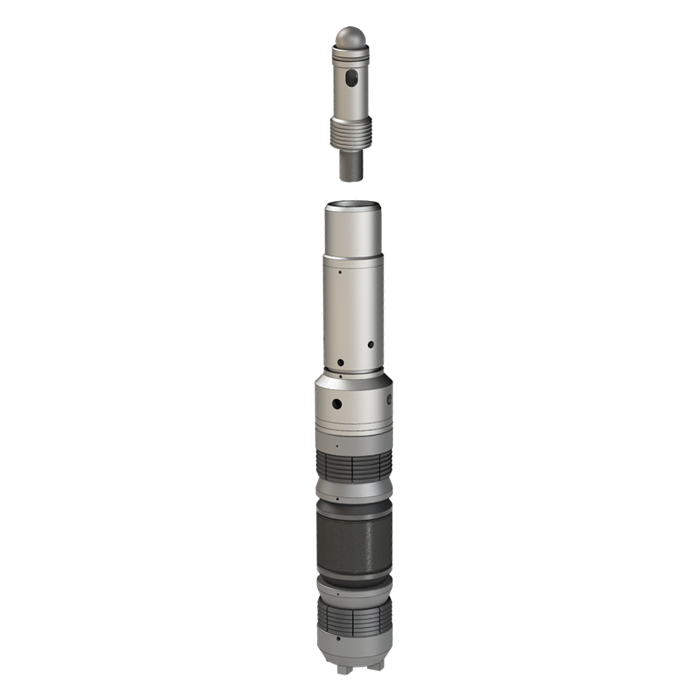
Hydro Mechanical Bridge Plug
Hydro Mechanical Bridge Plug
This plug transforms the setting process by using hydraulic power to engage the top slips, followed by mechanical pull to finalize the set. Unlike traditional methods, there’s no need for a separate mechanical setting tool, as this functionality is integrated into the plug itself.
The process is simple: a ball is inserted into the tubing string, blocking the built-in equalizing ports. Pressure is then applied to activate the top slip, and mechanical pull ensures the set is secure. To release, a right-hand rotation of the tubing string disengages the plug.
Once released, the full internal diameter of the tubing is restored, enabling easy passage of additional equipment through the tubing string.
Features and Applications
- The primary purpose of a bridge plug is to achieve zonal isolation during well operations such as hydraulic fracturing (fracking), well testing, or stimulation treatments. By isolating individual zones, bridge plugs prevent fluid migration between different sections of the wellbore, allowing targeted treatment and optimized production.
- Bridge plugs contribute significantly to well integrity by acting as a mechanical barrier that blocks unwanted fluid flow.
- Temporary or Permanent Sealing Depending on operational requirements, bridge plugs can serve as temporary or permanent sealing devices. Temporary bridge plugs are often used for short-term isolation during testing or stimulation. Permanent bridge plugs are used for well abandonment or long-term zonal isolation to comply with regulatory standards.
Technical Parameter
- Pressure Rating: up to 10,000 psi (maximum).
- Temperature rating: up to 450°F
Material
- L-80, P110, 13% Cr 1 Moly, INCONEL-825, AISI 4140 80/110 KSI
Elastomer
- Nitrile, Viton, HNBR, Aflas, PTFE, Silicon
Size
- 4-1/2 to 20.0 in
| TECH UNIT No. | 043 |
|---|---|
| MODEL | VE-HM-BP |